

Estimated reading time: 7 minutes
Key Takeaways
- Non-profits and associations lose staff hours every week to work that AI can now do in minutes: donor appeals, member renewal emails, board reports, grant summaries, and social content.
- Generic AI advice fails mission-driven organizations because it ignores donor trust, member retention, PIPEDA, and the reality of a five-person team doing the work of fifteen.
- The AI Advantage gives you 101 sector-specific strategies, each with a ready-to-use prompt, organized into 7 chapters so you can go straight to your most pressing problem.
- Chapter 6 is built specifically for associations: renewal sequences, member communications, and job postings that attract mission-aligned candidates.
- The book costs $37, works with any AI tool you already have, and most readers finish their first task inside 20 minutes of opening it.
Table of Contents
1. Your Team Is Already Maxed Out
Every non-profit and association leader we work with is running the same math problem. The mission keeps growing. The team doesn’t. Somewhere between the grant deadline, the board report, and the member renewal campaign, something gets rushed or dropped entirely.
Grant proposals take three days to write. Donor thank-yous read like every other charity’s, generic and forgettable, quietly costing you renewals you’ll never trace back to the cause. The to-do list never actually gets shorter, no matter how many evenings your staff give up.
Our communications team is a team of one. Me. AI gave me a way to show up like a team of five, and the donor appeal prompts alone recovered four major donors in a single campaign. — Jennifer L., Communications Manager, National Charity
None of this is a staffing problem you can fix by hiring. It’s a workflow problem, and it’s exactly what The AI Advantage: 101 Ways Non-Profits, Charities, and Associations Can Work Smarter, Reach Further, and Do More Good was written to solve.
2. Why Generic AI Advice Doesn’t Work Here
Search “AI prompts for business,” and you’ll find thousands of them. Almost none apply to your organization. A prompt built for a sales team assumes a product, a quota, and a customer who expects to be sold to. Your donors expect stewardship. Your members expect a return on their fees. Your board expects a report that respects their time.
2.1 Donor and member trust changes the prompt
A generic marketing prompt optimizes for conversion. A donor appeal has to optimize for relationship. That’s a different set of instructions, and it’s why copy-pasting business AI advice into a fundraising context tends to produce something that reads as corporate rather than mission-driven.
2.2 Canadian compliance isn’t optional
If your organization handles donor or member data, PIPEDA applies. Most AI guides written for a general audience never mention it. The book references Canadian privacy considerations throughout, alongside the broader non-profit and charitable landscape, so the prompts you use don’t create a compliance problem while solving a time problem.
2.3 One person, five roles
The organizations that need this most are the ones where a single staff member handles communications, fundraising, programs, administration, and board liaison at once. Advice written for a marketing department with six specialists doesn’t map onto that reality. Advice written for a five-hat generalist does.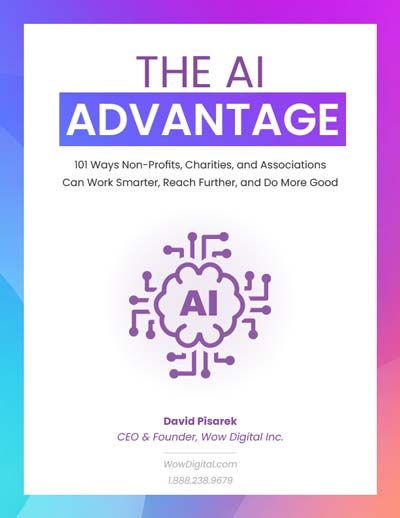 New Book from David PisarekSteal 101 Proven AI Prompts for Non-Profits and AssociationsGrant proposals taking three days? Member renewals slipping through the cracks? The AI Advantage gives you a copy-paste prompt for every one of its 101 strategies. Works with any AI tool you already use.Get Instant Access for $37
3. What’s Inside The AI Advantage
101 strategies, each with its own copy-paste prompt, organized into 7 chapters so you can open the book and go straight to what’s on fire this week.
3.1 Fundraising and Donor Engagement (Tips 1–18)
Lapsed donor re-engagement, legacy gift conversations, and appeal copy built to raise more, not just sound polished.
3.2 Marketing and Communications (Tips 19–33)
A month of social content drafted in one sitting, press releases in 10 minutes, and a consistent brand voice your whole team can use without a style guide meeting.
3.3 Program Delivery and Client Services (Tips 34–48)
Smarter intake, faster referrals, after-hours chatbots that answer questions at midnight, and follow-ups that stop falling through the cracks.
3.4 Operations and Administration (Tips 49–63)
Board reports in minutes, grant agreements summarized, and compliance checks that don’t require a lawyer for every question.
3.5 Advocacy and Community Engagement (Tips 64–75)
Advocacy toolkits, plain-language policy briefs, and campaign assets built to spread rather than sit unread.
3.6 People, Practice and Associations (Tips 76–90)
Job postings that attract mission-aligned candidates, and renewal sequences built to recover members before they lapse for good.
3.7 Your 30-Day AI Fast Track (Tips 91–101)
A practical launch sequence that takes your team from zero to running, one week at a time.
4. Why Associations Get Their Own Chapter
Non-profits raise donations. Associations retain members. Those are different problems that happen to look similar from the outside, and most AI content aimed at “non-profits” quietly assumes fundraising is the whole story.
Chapter 6 was built to close that gap. It covers member renewal sequences timed to catch lapses before they happen, job postings written to attract people who actually believe in the field, and communications built around the value a member gets for their fee rather than a donation ask they never made.
I’ve been sceptical of AI hype, but David doesn’t oversell it. Every tip is grounded and specific to what associations actually deal with. We rolled out the 30-day fast track and our board was impressed with week-two results. — Robert C., CEO, Professional Association
5. A Prompt You Can Steal Right Now
Every one of the 101 tips comes with a prompt exactly like this one, ready to drop into Claude, ChatGPT, Gemini, or whatever AI tool your team already has open.
Act as a non-profit fundraising specialist. I need to write a personalized donation appeal email for a donor named [NAME] who has given [TOTAL AMOUNT] over [TIMEFRAME], primarily to our [PROGRAM NAME] program. Their last gift was on [DATE].
Draft a 180-word appeal email that:
• Opens by referencing their specific past support
• Shares one concrete outcome from that program
• Closes with a warm ask of $[AMOUNT]Tone: grateful, hopeful, direct.
Swap the fundraising context for membership renewal, board reporting, or advocacy, and the same structure holds. That’s the pattern across all 101 tips: specific enough to use as-is, flexible enough to make your own.
6. Getting Started This Week
You don’t need technical skill to use this book. You need an email inbox and twenty minutes. Copy a prompt into any free AI tool, fill in your organization’s details, and you’ll have a usable draft before your coffee goes cold.
The AI Advantage is a one-time $37 download. No subscription, no software to install, and no reason to wait for budget approval on something that costs less than a team lunch.
Frequently Asked Questions
Do I need to be technical to use this book?
No. Every strategy is written for non-profit and association professionals, not IT staff. Copy a prompt into any free AI tool and you’ll have a usable result in seconds.
Which AI tools do these prompts work with?
All 101 prompts are tool-agnostic. They work with Claude, ChatGPT, Gemini, Microsoft Copilot, and any other AI assistant that accepts text prompts. Free tiers are sufficient for most of the strategies.
Is this useful for a small team where one person wears five hats?
That’s exactly who it was written for. The prompts are structured so a single staff member can produce the output of a larger team.
Does the book address Canadian privacy rules?
Yes. It references PIPEDA and the Canadian non-profit and charitable landscape throughout, alongside strategies that apply globally.
Can my whole team use one purchase?
Your purchase includes a single licence for personal or organizational use, covering you and your immediate team at one organization. Team and multi-site licences are available at wowdigital.com.






0 Comments