

Estimated reading time: 10 minutes
Key Takeaways
- AI is a force multiplier – Non-profits using AI strategically are doing more with less, faster than ever before.
- Donor data is off-limits – Never input personally identifiable information into any AI tool. Full stop.
- Content creation gets supercharged – One piece of content can become ten across email, social, and video with AI’s help.
- Fundraising strategy improves – Anonymized, aggregated data can be used to model scenarios and sharpen campaigns.
- Operations become leaner – From SOPs to board summaries, AI saves your team hours every single week.
Table of contents
Artificial intelligence is no longer a buzzword reserved for Silicon Valley startups and Fortune 500 companies. It has officially arrived in the non-profit sector, and the organizations that embrace it thoughtfully are already pulling ahead, doing more with less, reaching more people, and making a greater impact than ever before.
But here is the thing: AI can also be misused as a tool. And in the non-profit world, where donor trust is everything, misuse is not something you can afford.
In this guide, we are going to cover 25 practical, actionable ways your non-profit, charity, or cause-driven organization can leverage AI today, along with the one hard rule you must never break when using it.
Let us get into it.
The One Rule That Overrides Everything Else
Before we dive into the good stuff, we need to talk about donor protection.
Never, under any circumstances, input donor names, contact information, giving histories tied to individuals, or any other personally identifiable information into an AI tool.
This is not just a best practice. It is a matter of trust, ethics, and in many jurisdictions, the law. Your donors have entrusted you with their information so you can advance your mission, not so it can be fed into a third-party AI system. Violating that trust, even accidentally, can cause irreparable damage to your reputation and your relationships.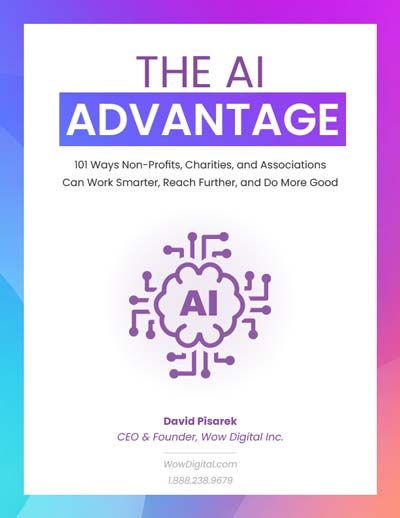 New Book from David PisarekSteal 101 Proven AI Prompts for Non-Profits and AssociationsGrant proposals taking three days? Member renewals slipping through the cracks? The AI Advantage gives you a copy-paste prompt for every one of its 101 strategies. Works with any AI tool you already use.Get Instant Access for $37
AI is your strategy engine, your content creator, and your productivity multiplier. Your CRM is where donor data lives and stays. Keep those two worlds completely separate.
With that firmly established, here are 25 ways AI can transform your organization.
Content and Communications
1. Draft Newsletters and Email Campaigns
AI can generate compelling, well-structured email copy in a fraction of the time it would take to write from scratch. Give it your campaign theme, your mission focus, and your audience, and it will produce a strong draft that your team can refine and personalize. You handle the heart. Let AI handle the heavy lifting of the first draft.
2. Repurpose Content at Scale
One strong piece of content can become ten.
Turn a blog post into a podcast script, a series of social media captions, a donor update, an email newsletter, and a short video script, all from the same source material. AI makes this kind of content multiplication fast, consistent, and efficient. For resource-strapped teams, this is a genuine game changer.
3. Write Grant Proposal Drafts
Grant writing is one of the most time-intensive tasks in the non-profit world. AI can help you structure narratives, develop compelling case statements, and draft answers to common funder questions. You still need your team’s expertise, data, and mission-specific storytelling to make it sing, but AI dramatically reduces the blank-page paralysis that slows so many organizations down.
4. Translate Content Into Multiple Languages
Reaching diverse communities is a core mandate for many non-profits. AI-powered translation tools allow you to adapt your communications, website content, and programme materials into multiple languages quickly and cost-effectively, helping you connect with the populations you serve more inclusively and authentically.
5. Generate Social Media Content Calendars
Planning a month of social content used to take hours. AI can generate post ideas, suggest hashtags, recommend content themes tied to awareness days and sector events, and even draft captions for every platform in your mix. Your team reviews, adjusts, and schedules. What used to take a full day can now take an hour.
Fundraising Strategy
Remember: aggregated, anonymized data only. No individual donor information enters the picture here, ever.
6. Analyze Aggregated Giving Trends
Using only anonymized, aggregate data, such as campaign totals, average gift sizes, peak giving periods, and channel performance, AI can help you identify patterns and opportunities in your fundraising data. Just numbers that help you make smarter strategic decisions.
7. Model Fundraising Scenarios
What would happen if you launched a matching gift campaign in November instead of December? What if you shifted 20% of your direct mail budget to digital? AI can help you model hypothetical scenarios and explore outcomes based on sector benchmarks and general fundraising principles, giving your team a smarter foundation for decision-making.
8. Write Compelling Donation Page Copy
Your donation page is one of the most important pages on your website. AI can help you write and test multiple versions of headlines, impact statements, and calls to action, so you can find what resonates most with your audience and drives more conversions.
9. Create Gift Acknowledgement Letter Templates
Every donor deserves a meaningful, timely thank you. AI can help you build a library of acknowledgement letter templates for different gift levels, campaign types, and donor segments. Your team then personalizes each one manually before it goes out, ensuring the warmth and specificity that donors deserve.
10. Brainstorm Fundraising Campaign Ideas
Sometimes you just need a creative spark. AI is an exceptional brainstorming partner.
Feed it your mission, your audience, the time of year, and your fundraising goals, and ask it to generate campaign concepts, names, themes, and angles. You will get ideas your team would never have thought of on its own.
Operations and Productivity
11. Summarize Board Meeting Notes
After stripping out any personally identifiable information, AI can turn lengthy meeting transcripts into clean, concise summaries that clearly highlight action items, key decisions, and follow-up responsibilities. Board governance becomes faster, cleaner, and easier to track.
12. Create and Refine Internal SOPs
Standard Operating Procedures are essential for organizational consistency, but writing them is nobody’s favourite task. AI can draft SOPs based on a process description, help you refine existing ones for clarity, and format them into professional, easy-to-follow documents your team will actually use.
13. Draft Job Postings That Attract Mission-Aligned Candidates
Finding people who genuinely care about your cause is everything.
AI can help you write job descriptions that clearly communicate your mission, culture, and values while hitting the right keywords to attract qualified candidates through job boards and search.
14. Build Volunteer Training Materials
Volunteer onboarding is often under-resourced. AI can help you develop training guides, FAQs, welcome documents, and scenario-based learning content that gets volunteers up to speed faster and sets them up for a meaningful experience with your organization.
15. Automate Internal Reporting Structure
Using anonymized operational data, such as programme outputs, volunteer hours, and service delivery metrics, AI can help you structure and draft internal reports faster.
Rather than spending hours formatting and writing, your team spends that time analyzing and acting on what the data is telling you.
Programmes and Impact
16. Analyze Anonymized Programme Outcome Data
When you remove all personally identifiable information, AI becomes a powerful analytical partner for your programme data.
It can identify trends, surface insights, and help you understand what is working and what needs to change in your service delivery, so your programmes keep getting better.
17. Develop Client Resource Guides and Community Toolkits
Whether you are building a mental health resource guide, a housing navigation toolkit, or a newcomer welcome package, AI can help you draft, structure, and format these materials quickly. What might take weeks can be done in days, with more time left for community review and refinement.
18. Build Chatbots for Your Website
A well-designed chatbot can answer your most common questions around the clock, guide website visitors to the right programmes, direct potential donors to your giving page, and reduce the volume of repetitive inquiries your team fields every day. AI-powered chatbots are more accessible than ever and can be a significant force multiplier for understaffed organizations.
19. Summarize Research Papers and Sector Reports
Staying current on sector research is important, but reading lengthy reports takes time that most non-profit leaders simply do not have.
AI can summarize key findings, highlight relevant statistics, and pull out the insights most applicable to your work, keeping your team informed without the time drain.
20. Generate Survey Questions for Community Needs Assessments
Strong programme design starts with understanding community needs. AI can help you develop thoughtful, well-structured survey questions for needs assessments, programme evaluations, and stakeholder feedback initiatives, saving your team hours of drafting and helping you capture better data.
Marketing and Brand
21. Create Website Copy for New Pages and Campaigns
Every time you launch a new programme, campaign, or service, you need new web copy. AI can draft compelling, SEO-informed copy for landing pages, programme pages, and campaign microsites that your team can then refine and publish quickly, without bottlenecks.
22. Brainstorm Campaign Names, Slogans, and Taglines
Brand creativity does not have to depend solely on an expensive agency engagement. AI can generate dozens of campaign names and tagline options based on your mission, your audience, and your campaign goals.
Use it as a brainstorming partner, and then bring your brand lens to choose and refine the best options.
23. Produce SEO-Optimized Blog Content
A consistent blog builds your organization’s authority, drives organic traffic to your website, and creates a resource library your community and donors will keep coming back to.
AI can help you research topics, outline articles, draft posts, and optimize content for search, making it much easier to maintain a content programme even with a small team.
24. Script and Outline Video Content
Video is one of the most powerful storytelling tools available to non-profits, but scripting is often a bottleneck. AI can help you outline and script impact stories, explainer videos, social reels, and YouTube content, so your team can focus on production and storytelling rather than staring at a blank page.
25. Analyze Peer Organization Messaging to Sharpen Your Positioning
Understanding how peer organizations in your sector communicate their mission, differentiate their work, and speak to donors can directly inform your own positioning strategy. AI can quickly analyze and summarize publicly available messaging from peer organizations, helping you identify white space and sharpen your own voice.
The Bottom Line
AI is not here to replace the people behind your mission. It is here to give them back time, expand what is possible, and help your organization punch well above its weight.
The non-profits that start building AI into their workflows today will have a significant advantage over those that wait.
And remember: the golden rule stands. Donor data stays out of AI. Full stop. Your donors trust you, and that trust is the foundation of everything you do.
Ready to Build a Smarter Digital Strategy for Your Non-Profit?
If you are wondering where to start with AI or how to build a website and digital presence that actually supports your mission and fundraising goals, Wow Digital is here to help.
We work exclusively with non-profits and charities, so we understand your world, your challenges, and what it takes to connect with your donors and community online.
Next steps:
- Book a free strategic call with our team
- Explore our Non-Profit Resources
- Take the self-assessment
Your mission matters. Let’s make sure your strategy does too.
Frequently Asked Questions
Is AI safe for non-profits to use?
Yes, when used responsibly. The key rule is to never input personally identifiable donor information into any AI tool. Use AI for strategy, content, and operations while keeping all donor data securely within your CRM.
How can non-profits use AI?
Non-profits can use AI to automate marketing, personalize donor communication, improve fundraising, analyze data, and streamline operations. AI tools help save time, reduce costs, and increase overall impact.
Do we need a big budget to start using AI?
Not at all. Many powerful AI tools have free or low-cost tiers. The bigger investment is time spent learning how to prompt and apply them effectively, which pays off quickly.
What is the easiest way for a non-profit to start with AI?
Start with content. Use AI to draft your next newsletter, social post, or grant proposal section. Once your team is comfortable, expand into operations and strategy.
Can AI help with grant writing?
Absolutely. AI can help structure your narrative, draft case statements, and answer common funder questions. Your team still provides the mission expertise and specific data, but AI significantly reduces the time required to produce a strong first draft.
How do we protect our donors when using AI?
Simple: keep donor names, contact details, and individual giving histories completely out of any AI tool. Only use anonymized, aggregated data for strategic analysis. Treat this rule as non-negotiable.
How often should we be revisiting our AI strategy?
AI tools evolve quickly, so a quarterly check-in is a good habit. Review what tools your team is using, whether new options have emerged, and how your usage aligns with your data protection policies.







0 Comments